Rabbit
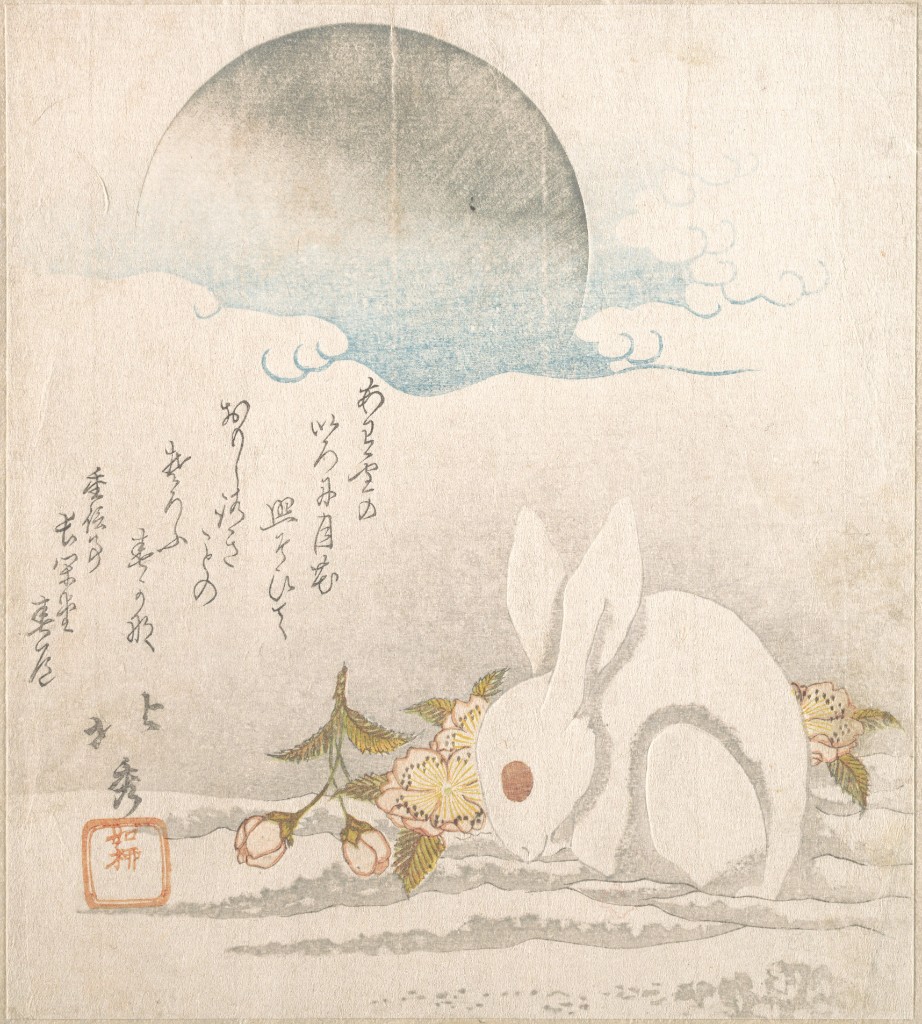
The moon rabbit is one of the most ancient and widely distributed mythological figures in East Asian culture, appearing in Chinese, Japanese, and Korean tradition with a consistency that speaks to the depth of its roots in the shared imaginative inheritance of the region. The legend originates in a Chinese myth of great antiquity — gazing at the full moon, ancient observers interpreted the dark patches on its surface not as craters or geological features but as the silhouette of a rabbit, and around this perception an elaborate mythological narrative accumulated over centuries. In the Chinese tradition the moon rabbit is companion to Chang'e, the immortal goddess who fled to the moon after drinking an elixir of immortality, and the rabbit is depicted eternally at work with a mortar and pestle, grinding the herbs from which further elixirs of immortality are prepared. This association with the moon — itself a symbol of cyclical renewal, the feminine principle, and the passage of time — and with the preparation of immortality medicines places the rabbit squarely within the broader East Asian symbolic complex of longevity, and its image in painting and decorative art carries these associations wherever it appears, the small creature's patient industry at its mortar a quiet emblem of the perpetual, unhurried work of nature renewing itself through its cycles.
In Japanese artistic tradition the moon rabbit — known as tsuki no usagi — was absorbed into a visual culture already deeply attuned to the symbolic resonances of moonlight, and it became one of the most beloved figures in the vast repertoire of imagery associated with the autumn moon-viewing festival of Otsukimi, a celebration of the harvest moon that has been practiced in Japan since the Heian period. Japanese paintings and woodblock prints depicting the moon rabbit tend to suffuse the image with the particular emotional quality of autumn moonlight — cool, luminous, faintly melancholy — that connects the rabbit's symbolism to the broader Japanese aesthetic preoccupation with impermanence and the beauty of transient natural phenomena. The full moon itself, in Japanese aesthetic thought, is an image of perfect and fleeting completeness — it will inevitably wane — and the rabbit's presence upon it deepens this symbolic register, the industrious little creature grinding away at its immortality medicines in a light that will not last the week. In Korea the moon rabbit similarly appears in folk painting and decorative art as a figure of gentle auspiciousness, its association with the moon lending it connections to the feminine, the cyclical, and the blessings of the harvest, and Chuseok — the Korean autumn harvest festival, often compared to Thanksgiving — carries within its moonlit celebrations an awareness of the rabbit's presence on the face of the full moon that has colored Korean culture's relationship to this image for as long as the festival itself has existed.