Mount Fuji
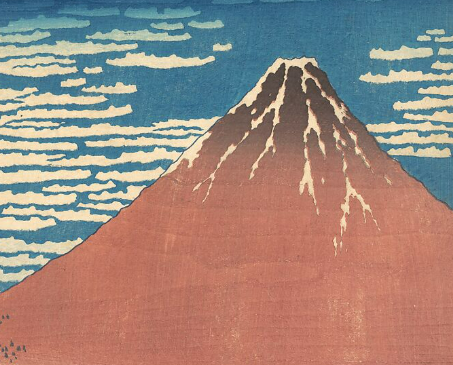
Mount Fuji occupies a place in Japanese cultural and spiritual life that transcends mere geography. As the tallest peak on the Japanese archipelago, it has been regarded since antiquity as a sacred axis — a point where the terrestrial and the divine converge — and was for centuries the site of Shinto and Buddhist pilgrimage, its summit considered a threshold between the mortal world and the realm of the gods. Its near-perfect conical symmetry, so distinctive as to seem almost architectural, reinforced this sense of the mountain as something set apart from ordinary nature, a form too composed and austere to be entirely of this earth. To paint Fuji was therefore never a purely aesthetic act but a devotional one — an acknowledgment of the mountain's spiritual authority and its role as a defining symbol of the Japanese land itself.
In the hands of the ukiyo-e masters, and particularly in the celebrated print series of Katsushika Hokusai, Mount Fuji accumulated a further layer of symbolic meaning as an emblem of the eternal set against the transient. Hokusai's Thirty-Six Views of Mount Fuji places the mountain in the background of scenes of ordinary human life — fishermen hauling nets, travelers crossing bridges, carpenters at work — while Fuji watches from the distance, unchanging, serene, and utterly indifferent to the passage of human time. This compositional strategy transforms the mountain into a meditation on impermanence, one of the central preoccupations of Japanese aesthetic thought: the world of human activity is fleeting and in constant motion, while Fuji endures. In this sense the mountain functions in Japanese painting much as certain landscape elements function in Chinese art — not as background but as philosophical presence, a silent protagonist whose stillness gives meaning to everything arrayed before it.