Monastery – Pavilion
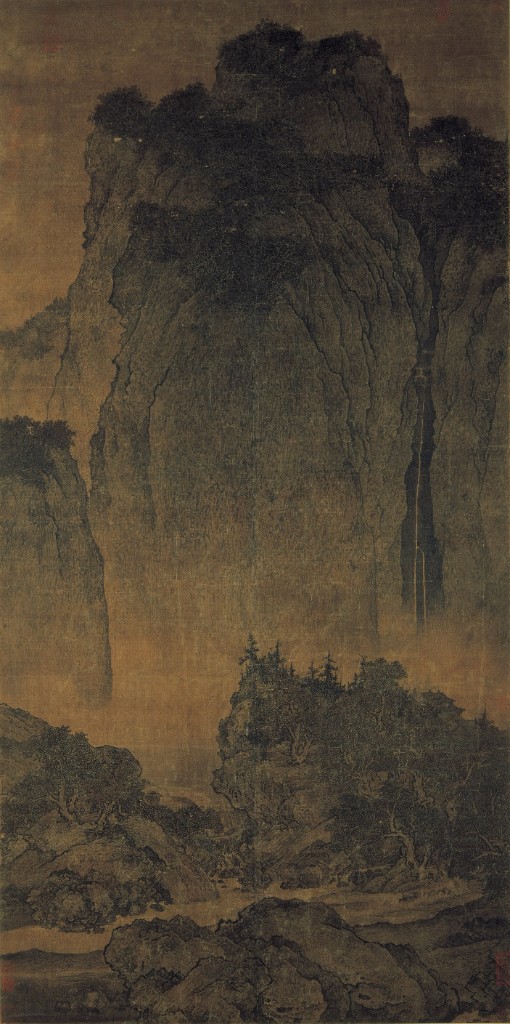
The monastery or pavilion nestled within a vast mountain landscape is one of the most philosophically charged compositional devices in the entire history of Chinese painting, and its meaning cannot be separated from the historical and intellectual circumstances in which the great landscape tradition developed. The Song dynasty — during which shanshui landscape painting reached its first and perhaps greatest flowering — was a period of recurring political turbulence, dynastic fragility, and the constant pressure of nomadic incursion from the north, and it was against this backdrop of instability that Chinese painters developed their distinctive vision of the natural world as a realm of permanence and order set against the chaos of human affairs. The monastery glimpsed behind a curtain of mist, clinging to a clifftop or tucked into the fold of a mountain valley, functions within this pictorial tradition as a symbol of civilization's quiet persistence — a sign that human spiritual endeavor, at its most disciplined and most removed from worldly ambition, partakes of the same enduring quality as the mountains themselves. It is not the imperial court, not the busy city, not the battlefield that survives the passage of dynasties, the painting suggests, but the monastery on the mountain, where monks have continued their practice indifferent to the convulsions of history below.
The solitary pavilion carries a related but distinct symbolic identity rooted more explicitly in the literati tradition and its cultivation of the ideal of withdrawal from official life. In Chinese philosophical culture, shaped by both Confucian and Daoist currents of thought, the tension between engagement with the world and retreat from it was one of the central preoccupations of the educated class — the scholar-official was expected to serve the state, yet the Daoist tradition celebrated the man who recognized the vanity of worldly ambition and withdrew into nature to cultivate his inner life in solitude and simplicity. The pavilion in a landscape painting is the architectural embodiment of this ideal of retreat — a human structure that does not impose itself upon nature but settles lightly within it, its modest scale dwarfed by the surrounding mountains in a compositional relationship that is itself a philosophical statement about the proper proportion between human ambition and the vastness of the natural order. Frequently the pavilion is occupied by a tiny solitary figure — a scholar gazing at the water, a sage contemplating the mountains — whose diminutive scale relative to the landscape around him is entirely deliberate, encoding the Daoist conviction that the cultivation of wisdom begins with the recognition of one's own smallness within the fabric of the universe. To paint the pavilion in the wilderness was therefore to paint an entire philosophy of the good life — modest, contemplative, attuned to nature, and liberated from the anxious striving that the great landscape tradition regarded as the defining and most pitiable condition of ordinary human existence.