Kitsune – Fox
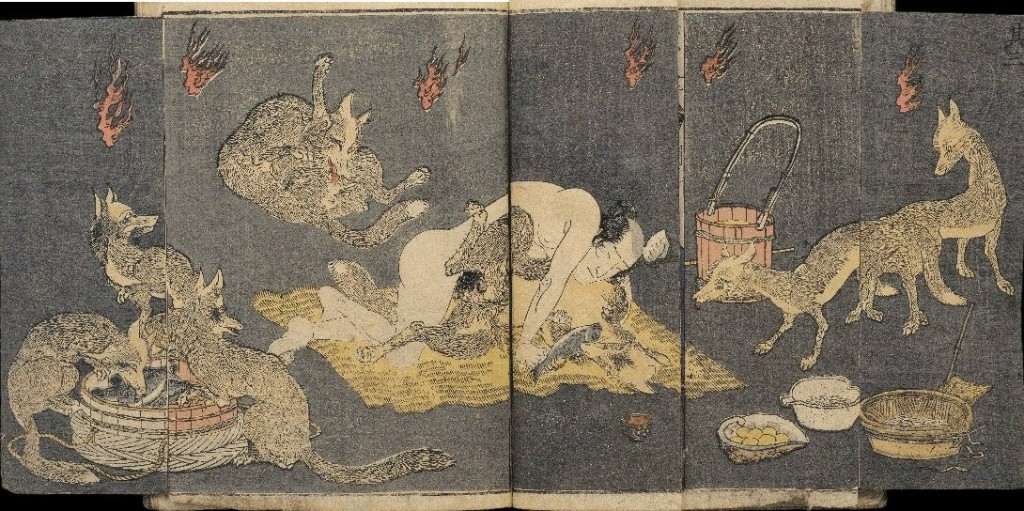
The kitsune — the fox spirit of Japanese folklore and artistic tradition — occupies a symbolic territory unlike almost any other creature in East Asian iconography, hovering perpetually between the benevolent and the dangerous, the sacred and the deceptive, the comic and the genuinely uncanny. In Japanese belief the fox is a being of accumulating supernatural power, growing more formidable and more mysterious with age, and the most celebrated marker of its spiritual advancement is the multiplication of its tails — a young fox possesses one, while a fox of nine tails has reached the pinnacle of supernatural potency, a being of immense and unpredictable power that commands both reverence and wariness. This image of the multi-tailed fox appears throughout Japanese painting and woodblock print culture with a frequency that testifies to its deep hold on the popular imagination, rendered sometimes as a terrifying supernatural predator and sometimes as a figure of almost playful mischief, its ambiguity preserved across centuries of artistic representation as an essential part of its symbolic identity. The kitsune is, above all else, a creature of transformation and disguise — capable of assuming human form, most typically that of a beautiful woman — and it is this shapeshifting quality that gives it its particular imaginative power, embodying Japanese culture's long fascination with surfaces that conceal entirely different realities beneath.
The kitsune exists in two distinct symbolic registers that run in parallel throughout Japanese art and literature without ever fully resolving into one another. In its divine aspect the fox is the sacred messenger and earthly embodiment of Inari, the Shinto deity of rice, agriculture, fertility, and worldly prosperity — one of the most widely venerated gods in the Japanese pantheon, whose shrines, marked by their characteristic rows of vermillion torii gates, are found in greater number than those of any other Shinto deity across the Japanese archipelago. In this capacity the fox is a figure of blessing and protection, and paintings and sculptural representations of white foxes flank Inari shrines as guardians of the sacred space, their supernatural intelligence harnessed in the service of divine will. Yet running alongside this protective, devotional identity is the kitsune's darker folkloric reputation as a trickster and a seducer, a creature that leads travelers astray, assumes the identities of loved ones, and undermines the stability of the human world through illusion and deception. It is the tension between these two natures — the divine messenger and the supernatural deceiver — that makes the kitsune such a compelling and enduring subject in Japanese painting, a creature whose symbolic richness derives precisely from its refusal to be reduced to a single, stable meaning, embodying instead the Japanese artistic sensibility's deep comfort with ambiguity, paradox, and the mystery of things that cannot be entirely known.