Dragon
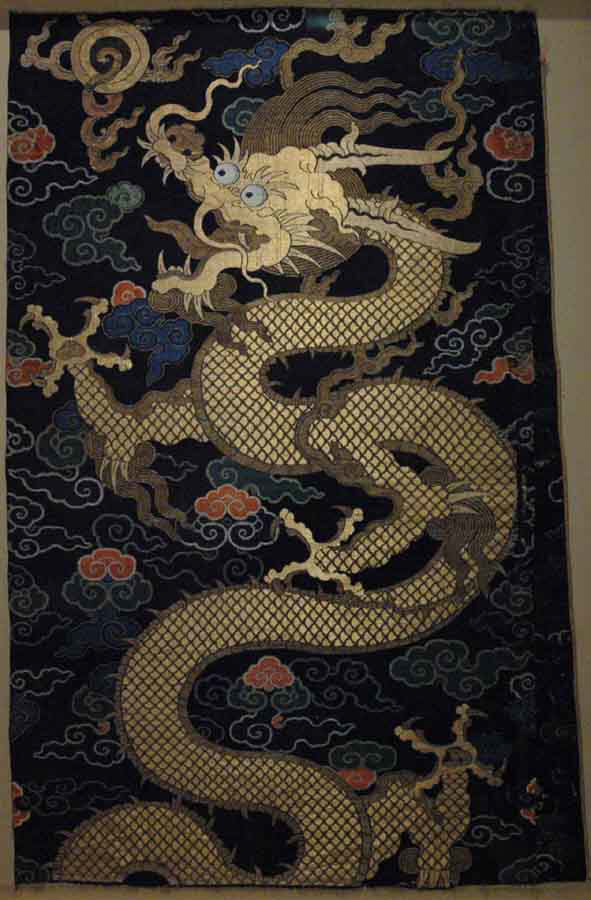
The dragon of East Asian tradition is a creature utterly unlike its Western counterpart, and visitors to these galleries would do well to set aside any associations with malevolence, destruction, or the fire-breathing monsters of European medieval imagination. In Chinese painting and decorative art, the dragon — known as the lóng — is a profoundly auspicious being, a celestial sovereign associated with imperial power, cosmic order, and the life-giving force of water. It commands the rains, governs the rivers and seas, and moves between heaven and earth as a messenger and embodiment of the yang principle — the active, generative, masculine force that in Chinese cosmological thought animates and orders the universe. To depict the dragon was therefore to invoke the highest registers of power and divine sanction, and its image was for long periods of Chinese history the exclusive visual property of the emperor himself, its appearance on robes, ceramics, and paintings a declaration of the Son of Heaven's mandate to rule.
In painting, the dragon is rendered according to a precise iconographic formula that accumulated and solidified over centuries: the body of a serpent, the scales of a fish, the claws of an eagle, the antlers of a deer, and the whiskers of a catfish, this composite anatomy encoding the dragon's dominion over all realms of the natural world simultaneously. It is almost always depicted in motion — coiling through storm clouds, ascending through mist, or descending toward churning water — and this dynamism is essential to its symbolic character, conveying the restless, generative energy of heaven itself. The flaming pearl that the dragon is so frequently shown pursuing or clutching is a symbol of wisdom, enlightenment, and the perfection of spiritual power, a goal forever sought and forever animating the dragon's celestial movement. In Korean and Japanese traditions the dragon retains much of this cosmological identity while acquiring additional local resonances — in Korea it is closely associated with the protection of the nation and the blessing of the sea, and Korean royal iconography drew deeply on the dragon's imperial vocabulary in ways that speak to the complex and creative relationship between these three civilizations and the symbolic languages they shared, adapted, and made distinctly their own.