Wind God and Thunder God
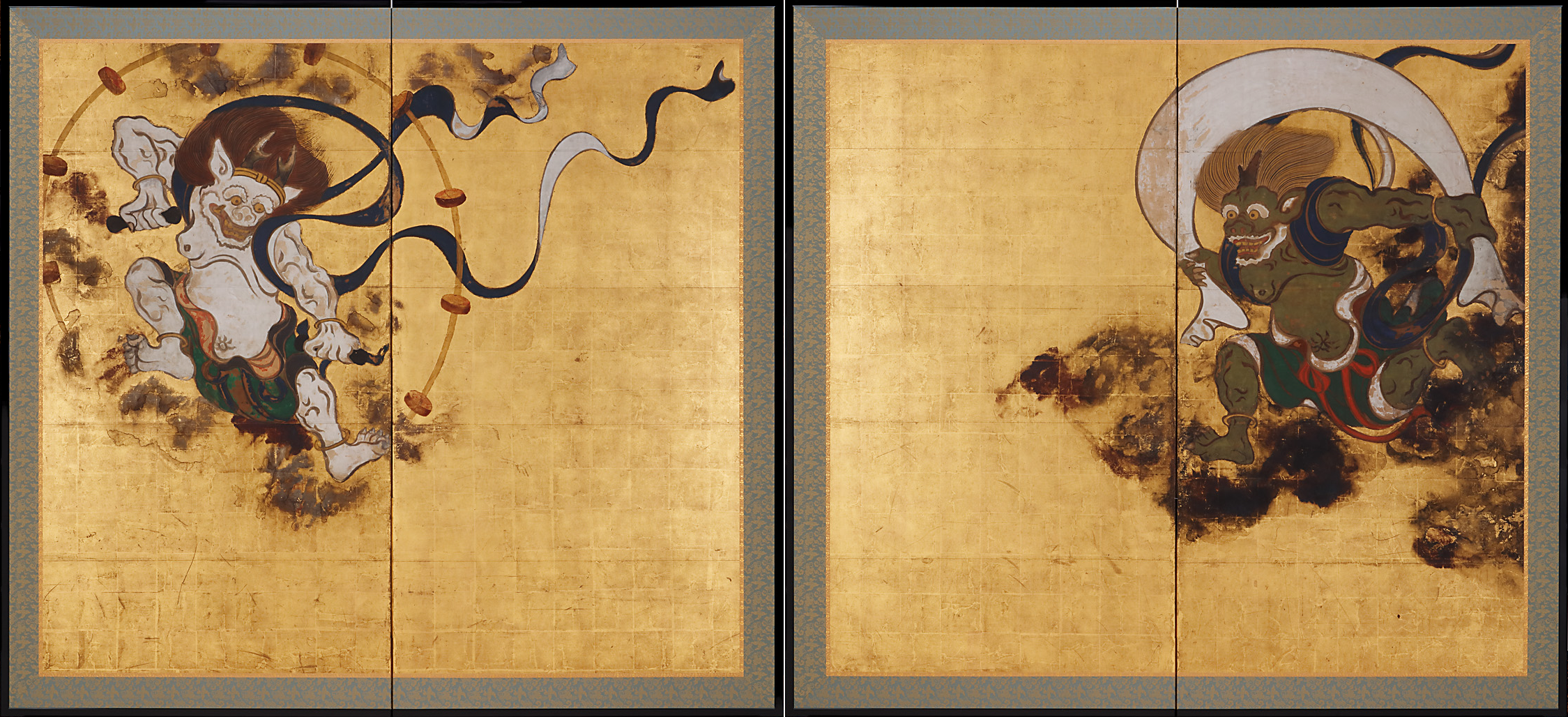
Wind God and Thunder God, painted by Tawaraya Sōtatsu in the early seventeenth century during the Edo period, is among the most immediately arresting and viscerally energetic works in the entire history of Japanese painting. Executed in ink, mineral pigments, and gold leaf on a pair of two-panel folding screens, the composition presents two supernatural deities hurling across an expanse of billowing gold cloud — Fūjin, the wind god, on the right screen, his green body contorted with kinetic energy as he grips a great bag of winds above his head, and Raijin, the thunder god, on the left, his body a vivid red as he strikes the ring of drums that encircles him and from which lightning and thunder are loosed upon the world below. The gold leaf background, rather than functioning as mere decoration, operates as pure atmospheric abstraction — a field of luminous, undifferentiated space that removes the two figures from any earthly setting and places them in a realm that is simultaneously nowhere and everywhere, elemental and eternal. Against this blazing ground, the swirling clouds and the contorted bodies of the gods achieve a compositional dynamism that feels almost shockingly modern for a work of the early 1600s.
Sōtatsu was a founding figure of the Rinpa school, one of the most distinctive and influential decorative painting traditions in Japanese art history, and Wind God and Thunder God represents that tradition at its most confident and inventive. The Rinpa aesthetic — characterized by bold, flat areas of brilliant color, gold and silver leaf grounds, and a deliberate rejection of the spatial illusionism pursued by Chinese and Western painting alike — finds in this composition perhaps its supreme expression, a work where decorative grandeur and raw supernatural power reinforce rather than contradict each other. The painting proved so compelling to subsequent generations that it was copied by two of the greatest painters of later Edo period Japan — Ogata Kōrin and Sakai Hōitsu both produced their own celebrated versions — a lineage of reinterpretation that is itself a testament to the original's canonical status in the Japanese pictorial tradition. The original screens are held at Kennin-ji temple in Kyoto, the oldest Zen temple in the city, where they remain objects of both artistic veneration and active religious significance, a reminder that for much of Japanese art history the boundary between aesthetic masterpiece and sacred object was not a boundary at all.